


Atop San Francisco
22 hours ago
Hark the herald angels sing,
'Glory to the new-born DuckRabbit'.
Hark The Herald Angels Sing
from the Christmas Song Generator.
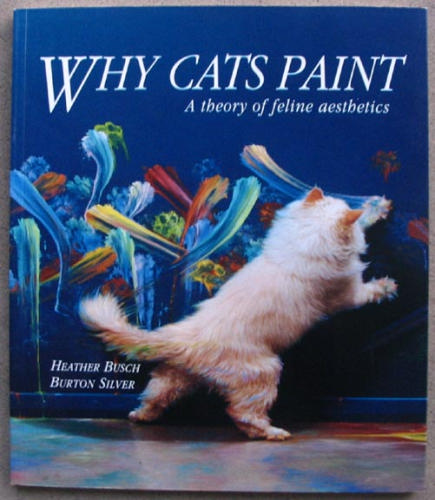
Front: MAX, Birdies (detail), 1991. Acrylic paste on painted wall. 86 x 130 cm. Private collection.Flipping through the book reveals many similar photographs of cats at work, or of the finished products themselves, some of which, like Birdies, are quite eye-catching. Are these cats really "painting"? One's first reaction cannot but be: no way (we know the titles how, for instance…?). But when John McEnroe exclaims "You cannot be serious!" he knows full well that they are: that's why he's upset about it. But this – is this a parody? A hoax? A sincere but deluded claim? (A startling discovery?) At first it's not clear.
Mutt, R. Decorative Retromingency. Urinary embellishment as a major problem in the curation of feline art. Journal of Non-Primate Art, Vol. XV, 1991.At first this isn't any more questionable than More Paw Less Claw. But of course "R. Mutt" is the signature on Fountain, Marcel Duchamp's infamous inverted urinal, to which this is a sly if unmistakeable reference – through the idea of "urinary embellishment" as well as to the issue of the artistic interpretation of found objects more generally. (There are other intentional giveaways: on p. 75, Bootsie's opus Cocking for Cockatoos (1993) is listed as being part of London's "Scraatchi Collection" – alluding to the actual Saatchi collection.)
As befits a reviewer [i.e., of Davidson's fourth volume of papers, Problems of Rationality] who is also a fervent disciple, I have used the space at my disposal to expound Davidson's views rather than to criticize them. I think that most of his critics have failed to grasp the audacity of his outlook—to realize that he is calling for what he once referred to as a "sea-change" in philosophical thinking. That change would make much of contemporary philosophical discussion seem as absurd as scholastic philosophy seemed to Hobbes and Descartes.With any luck (and subject to the by now familiar caveats), the same may be said of Rorty's work as well.
Davidson had no taste for polemics, and he was too courteous ever to adopt a merely dismissive tone toward colleagues with whom he disagreed. But his ideas were as radically subversive of the traditional problematic of post-Cartesian philosophy as were Wittgenstein's.
Many who have no use for Wittgenstein have none for Davidson, and for the same reason: to adopt the views of either would be to dissolve problems which they have spent the best years of their lives trying to solve.
Wittgenstein is no longer much read in graduate philosophy programs, and perhaps Davidson too will cease to be assigned. But if these five volumes of essays do suffer the neglect presently being suffered by Philosophical Investigations, they will remain, like time bombs, on the library shelves. They will be detonated sooner or later.
What Robinson really wants to talk about is why primitivism is the best way of life, why outdoorsy people are the only completely realized humans, why rock climbing is so interesting, and why Californians should be infinitely more snobby about their state than New Yorkers could ever be about New York. These themes interrupt Sixty Days so frequently, and at such length, that they essentially hijack whatever the book was trying to be.How about the natural disaster angle? In this first book, at least, not much actual climate change occurs – there's a big storm and flood in DC, and the Arctic ice is breaking up, affecting the ocean currents – but nothing really exciting. I suppose this is part of KSR's point, that it won't go down like The Day After Tomorrow, but it doesn't exactly make for interesting reading. There is a suggestion, in a subplot involving Tibetan exiles, of possible future paranormal activity (this is a science fiction book, after all), but I'm afraid I'm not going to stick around to find out.
I would like Robinson to go back to his word processor and give Sixty Days a fair shot, dispensing with the kayaking, backpacking, rock climbing, and feral life. That book would be more like a novel -- but unsatisfying, I suspect, to Robinson. And thus we are left with this question: if Kim Stanley Robinson's main priority is to preach primitivism and impress upon us the virtues of the California landscape and outdoor sports, does he really want to be in the business of writing novels, or is there a better way to communicate this?
While analytic philosophy is going to proceed with the demand for argumentation from premise to conclusion, much continental thought moves along the lines of engaging in qualitative description to explore a given line of inquiry. The goal would seem to be to develop the subject, rather than reduce it to a final conclusion. [...] No responsible thinker would push for intentional confusion. At the same time, there is such a thing as too much specificity. More so, there is definitely such a thing as too much deduction. A lesson the analytic school of philosophy still needs very badly to learn: moving only within the loop of premise to conclusion, the relevant qualities of the issues are often lost, and the real clarifying force of language is forfeited.This is much better, but I'm not sure that this is quite what I would say. First, it doesn't seem that the issue concerns specificity exactly. We might, for instance just as well say that there is such a thing (and that this is an indulgence to which analytic philosophers are characteristically susceptible) as too much generality. But that just means that I don't particularly want to say either of these things: the point is symmetrical. Every specific claim is a generality at the next lower level, and every general claim is (obviously) the specific claim that it is. If there's a problem here (i.e. with analytic philosophy), it concerns something a bit different than specificity or generality.
Philosophers disagree profoundly about what the best way to do philosophy is.That's true enough, and philosophy students should indeed be aware of this if they're not already. The rest of the statement gives the UM department view of what this difference is. It's pretty much the same as the standard line we've heard before from Leiter et al (Leiter calls it "one of the more sensible things I've seen written about this topic"), and I was going to let it go, but in the comments to my last post Colin asks nicely what my view is, so let me try to say a few things.
The much-discussed ‘analytic/continental’ divide was an artifact of the conviction, held by many English and American philosophers into the 60’s and 70’s, that analysis was the only way of doing philosophy. As this conviction becomes less widely held, and as analytic philosophers expand their areas of interest, the distinction is becoming less and less significant -- with the result that even predominantly analytic departments like Michigan generally offer courses covering all the major ‘continental’ figures.See, we're overcoming our old closed-mindedness about that other stuff; we even teach it! But as we know if we've seen this before, when "analytic" philosophers give up the notion that "analysis [is] the only way of doing philosophy", what this means is that they no longer believe that what they do is characterized by a particular philosophical method of "analysis." Instead, what they do is characterized more generally as "valuing clarity and precision in formulating philosophical positions, and scrutinizing arguments carefully" -- or, as Leiter tends to put it, simply philosophy done well. The only thing preventing others from overcoming that artificial divide and doing philosophy well themselves, then, is their apparent preference for gnomic obscurity, or perhaps simple charlatanry (like ... well, you know, the usual suspects). And now that we know this, we can go ahead and teach "continental" philosophers ourselves (at least those, like all of those listed -- Hegel, Marx, Nietzsche, Kierkegaard, Husserl, Heidegger, Sartre and Foucault -- who are safely dead); but properly now, i.e. formulating their positions clearly and precisely, and scrutinizing them carefully (instead of, I don't know, "interpreting" them like a holy text or something).
Still not sleeping,As it says on the back of the disc (tweaking Hamlet, no doubt): "fat chance to dream".
I tried counting sheep.
One by one,
they leapt across the fence
constructed for them.
Right to left,
across the fence I had constructed.
Having jumped,
they refused further direction.
Each sheep, where it landed,
refusing to exit, remained.
(Creating a vast writhing heap
growing fast on the left).
Try as I might,
I could not stop them entering
once again.
Try as they might,
not one could leave the stage.


